
When Bees Wake Up: The First Warm Days of Spring


Somewhere around the first warm day of the year, the bees return to the air.
You might not notice it at first. The fields still look quiet, and the trees are only just beginning to stir. But if you stand near a hive on a mild afternoon — when the temperature climbs past 55° or 60° — you’ll start to see it.
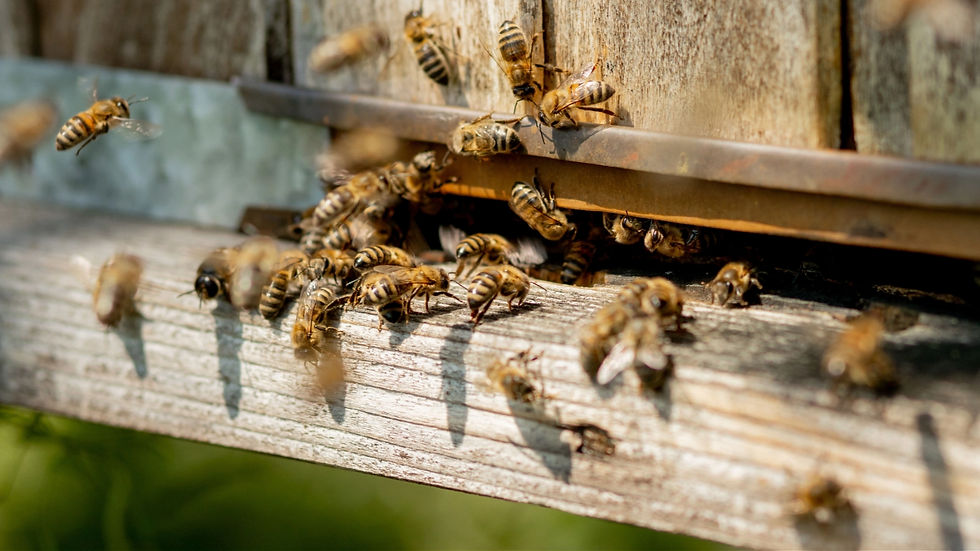
A few bees leave the entrance, circle briefly in the sunlight, and find their way back home.
To most people, it passes unnoticed.
But on a farm, that small moment means something important.
It means the colony made it through winter.
It means the hive is alive and beginning to move again.
And it marks one of the first quiet signals that the growing season has begun.
What Bees Were Doing All Winter
Honey bees don’t hibernate the way many insects do.
Instead, they survive winter by forming a tight cluster inside the hive. Thousands of bees gather around their queen, vibrating their flight muscles to generate heat. Even when the outside temperature drops well below freezing, the center of the hive remains warm enough to keep the colony alive.
Throughout the winter, bees survive by consuming the honey they worked all summer to produce — the same raw honey from the farm many visitors enjoy each season.
It’s a remarkable system — one that has allowed honeybees to survive cold winters for millions of years.
From the outside, the hive may look silent and still.
Inside, it’s anything but.

When Do Bees Come Out in Spring?
When temperatures finally rise into the mid-50s or 60s, the bees begin to leave the hive again.
Beekeepers call these early trips cleansing flights. After spending weeks inside the hive, the bees take short flights outside before returning again.
Soon after, worker bees begin searching for the first pollen sources of the season — often from early bloomers like maple and willow trees.
For beekeepers preparing their own hives for the season ahead, spring is also the time when many colonies are established. We offer 3‑lb bee packages with a mated queen each spring for those starting or expanding their apiaries.
These early flights may seem small, but they are the colony’s signal that the growing season is beginning.
And once the bees begin flying, the rhythm of spring slowly begins to build.
The Invisible Backbone of Agriculture
Most people rarely stop to think about bees while they’re eating.
But the work that begins with those early spring flights supports a tremendous portion of the food we grow.
Honeybees pollinate crops like apples, berries, cucumbers, pumpkins, melons, almonds, and countless fruits and vegetables. Without pollination, those plants simply wouldn’t produce the harvests we depend on.
In many ways, bees are the invisible backbone of agriculture.
Across orchards, farms, gardens, and wild landscapes, they quietly move pollen from flower to flower — helping plants reproduce, and crops grow.
They do their work largely unnoticed, yet the results show up everywhere: in farmers’ fields, at grocery stores, and on dinner tables across the country.
What It Means on the Farm
On the farm, those first bees in the air are always a welcome sight.
If you visit the farm on one of those mild early-spring afternoons, you might notice a few bees circling near the hive entrances, beginning their first flights of the season.
They mean the colony survived the winter months.
They mean the hive is waking up.
And they remind us that spring is already beginning to unfold — even if the fields still look quiet from a distance.
Spring doesn’t arrive all at once.
It begins with small signs.
A warm afternoon.
A few buds on a tree branch.
A handful of bees leaving the hive.
And from those small moments, the entire growing season slowly comes to life.
A Small Sign of a Big System
The next time you see a bee drifting through the air on a warm early-spring afternoon, there’s a good chance it’s part of the first wave of workers beginning the season’s work.
It might seem like a small thing.
But that tiny insect is part of a system that supports much of the food we eat and the agriculture that feeds the world.
Around here, it’s one of the clearest signs that spring — and the season ahead — has truly begun.
🐝 Experience the Bees Up Close

Spring is one of the most fascinating times in the life of a hive. After months of winter, the colony begins to stir again as worker bees take their first flights and the season's rhythm returns.
If you’ve ever been curious about what happens inside a hive, our Beekeeper Experience offers a chance to step into the world of beekeeping and see the bees up close.
You’ll suit up alongside a beekeeper, open a working hive, and experience firsthand the remarkable system that helps support farms, gardens, and agriculture across the country.
It’s one of the most memorable ways to experience the farm — and to see the tiny workers that quietly help feed the world.


Comments